
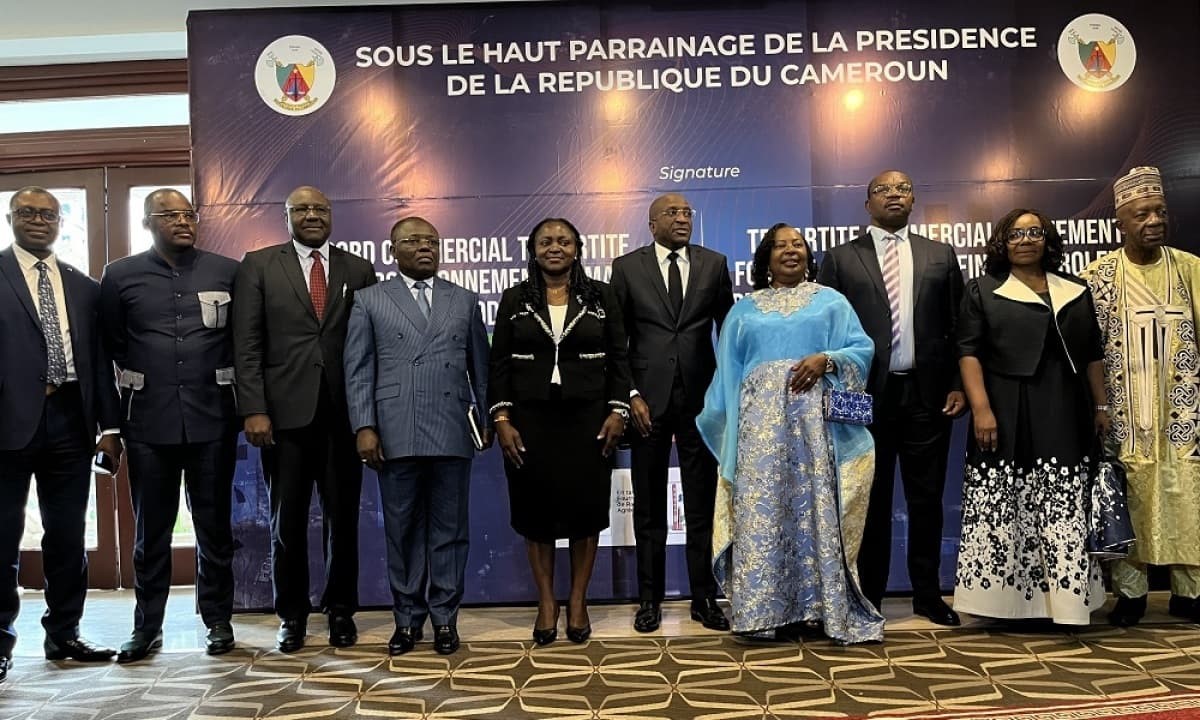
On 22 October 2026, the National Refinery Company of Cameroon (SONARA) signed a 30-month contract in Lagos with the Nigerian group Dangote and MRS Oil & Gas. The agreement concerns the supply and delivery of refined petroleum products to the Cameroonian market, still dependent on imports since the national refinery shutdown in 2019.
According to the information provided, the contract allocates responsibilities between the three partners: Dangote will supply refined products, MRS will transport them and logistical operations, while SONARA will be the buyer and national distributor. MRS will also take responsibility for the risks associated with the quantity, quality and assurance of shipments until they arrive in Limbe, in the south-west of the country.
However, the volumes concerned remain to be clarified. Some sources refer to 50 per cent coverage of national needs, while others indicate that Dangote will provide half of the estimated 80 per cent share of SONARA in the market.
This difference does not allow for a single rate. The context remains marked by the weight of imports: according to data reported by EcoMatin, Cameroon imported 2.02 million tonnes of white petroleum products in 2025, for an invoice of approximately 1.2 billion euros.
The assembly also provides for a banking guarantee mechanism between the partners. MRS must issue a letter of credit in favour of Dangote, while SONARA will issue one to MRS.
The purpose of this scheme is to secure the payment of cargoes, while the public company faces difficulties in financing its purchases directly. In September 2026, it had also obtained funding of EUR 189 million from the Islamic International Trade Finance Corporation (ITFC) to support its operations.
This agreement organizes imports in the short and medium term, but does not address the issue of national refining capacity.
The reconstruction of SONARA, estimated at approximately EUR 1.1 billion, provides for a processing capacity of 3.5 million tonnes of crude oil per year. Its implementation remains conditional on the mobilization of financing, the completion of work and the securing of supplies of crude oil.