
The Comprehensive Economic Partnership Agreement (CEPA) between the Democratic Republic of the Congo and the United Arab Emirates entered into force on 30 October 2026. In particular, it provides for the reduction of tariffs, the simplification of trade procedures and the development of investment in several sectors, including logistics, energy and industry.
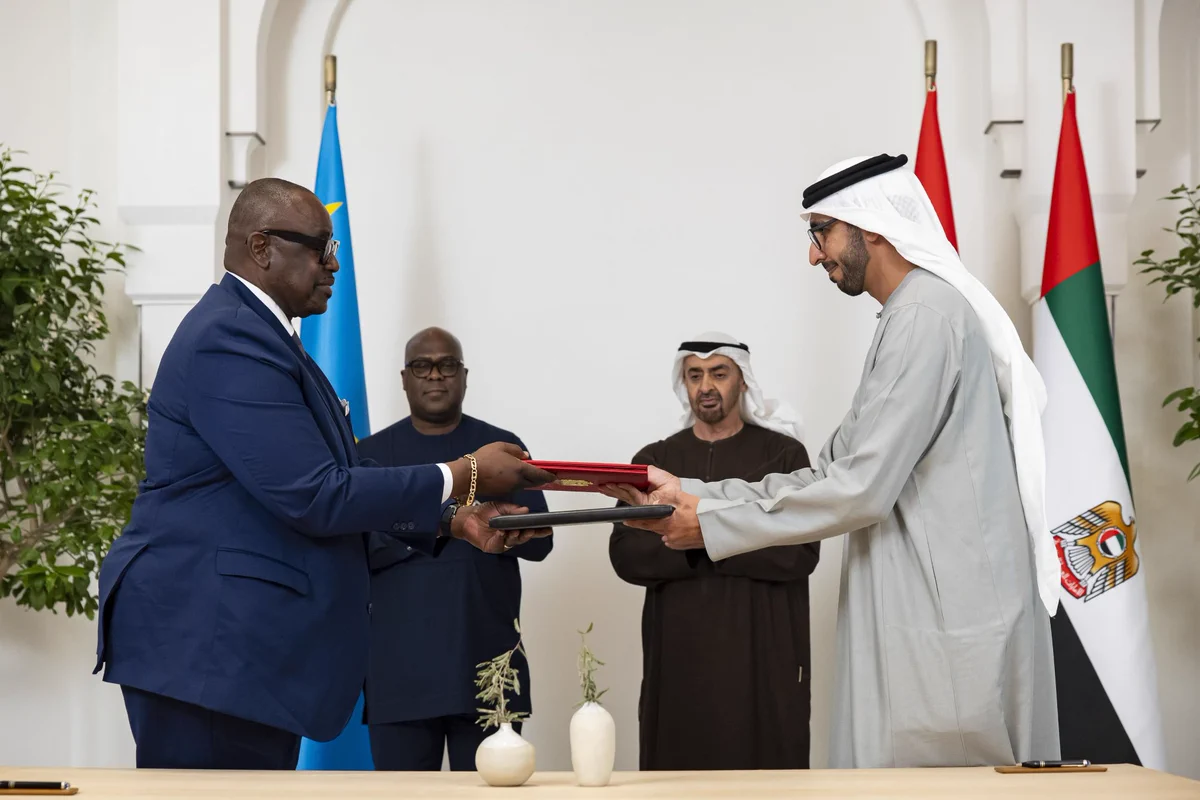
The Comprehensive Economic Partnership Agreement between the Democratic Republic of the Congo (DRC) and the United Arab Emirates (UAE) is now applicable. Signed on 2 February 2026 in Abu Dhabi, it provides for the abolition of customs duties on the vast majority of tariff lines, the harmonization of customs procedures and the reduction of barriers to trade.
The scheme also aims to facilitate bilateral investment, particularly in logistics, energy and manufacturing. For companies, these provisions should simplify access to both markets and facilitate business operations between partners.
This entry into force follows an increase in bilateral non-oil trade. According to the United Arab Emirates News Agency (WAM), their value reached $3.5 billion in 2025, an increase of 38.5 per cent over 2024. In particular, the Emirates exports vehicles, machinery, electronic equipment and construction materials to the DRC.
In contrast, the Emirati market receives metals, food, cotton and other Congolese agricultural products. Both countries thus have trade flows covering several categories of goods, including raw materials and industrial equipment.
The DRC is also of interest to investors because of its mineral resources and geographical location. The country is the world's largest producer of cobalt, with over 70 per cent of the world's supply, and the largest producer of copper in Africa.
It also has gold, tin, tantalum and tungsten reserves. With common borders with nine countries, it is a gateway to markets in Central and Eastern Africa.
The Emirati authorities see this agreement as an opportunity to expand the opportunities of their exporters and investors in this region. The Emirati Minister for Foreign Trade, Thani bin Ahmed Al Zeyoudi, highlighted the potential for cooperation between the private sectors of the two countries.
For both partners, the challenge is now to realize the trade and investment opportunities envisaged by CEPA.
In particular, the DRC will need to leverage its resources to develop exports and local transformation, while companies in both countries will be able to explore new opportunities in the sectors concerned.
The UAE Economic Partnership Agreement programme is part of a broader strategy for the development of international trade relations. According to WAM, the country has concluded such agreements with 40 States, 20 of which have already entered into force.