

For a long time seen as an essentially administrative function, the Purchasing function now occupies an increasing place in the management of business performance. In Guinea, as in the rest of the African continent, its professionalization poses challenges of skills, process structuring, risk control and digitalization. Director of LAMS Consulting, Moussa Oularé analyses this evolution and looks back on the levers that can enable companies to better exploit their expenses, data and supplier relationships, while gradually integrating artificial intelligence and the requirements of responsible purchasing.
- You built your professional career around Purchasing and Supply Chain before creating LAMS Consulting. What led you to specialize in these trades and create your own firm?
My journey was gradually built around Operations Management, Supply Chain and Purchasing. After my Master 2 in Operations Management with a training including Production Management, Logistics, Purchasing and Supply Chain, I had the opportunity to perform various functions: flow management, continuous improvement, procurement, Supply chain and then in procurement: public procurement, strategic procurement, project management Procurement, management and transformation of the procurement function.
What really led to a shift towards purchasing is first the cross-cutting nature of this profession. The buyer is at the crossroads of many of the company's functions: operations, finance, Supply Chain, technical functions, legal, quality, CSR, but also suppliers. And that's exactly what made me passionate: understanding a need, analysing a market, looking for the right suppliers, negotiating, building a partnership relationship and finding the best solution for the company.
I also found that the Purchases allowed for a very concrete impact on the company's performance. A good decision Procurement can generate savings, of course, but it can also reduce risk, secure a supply, improve quality, optimize the total cost of ownership, encourage innovation or contribute to the development of the customer-supplier relationship.
It is therefore a profession that combines what I particularly appreciate: the Procurement Strategy, negotiation, the data management applied to Purchases, the management of purchasing projects, the challenge of prescribers, the human dimension through, inter alia, ethics, fair treatment, compliance with commitments, listening, the relationship of trust and above all the creation of value.
Because, in addition to numbers and contracts, Procurement remains primarily a business of relationships, both with internal customers and with its external environment, including suppliers.
Then I had the opportunity to carry out various missions Purchases from large organisations in a wide variety of sectors and environments: telecommunications, transport, energy, Smart Infrastructure, environment, rail (procurement), construction/BTP or Oil & Gas.
All of this career has reinforced my choice to continue my evolution in Purchasing and has allowed me to develop a very transversal vision. In particular, I understood that a purchase decision must never be taken in isolation. Behind a purchase there is an operational need, a budget, delays, risks, quality requirements, but also an impact on the overall performance of the company.
It is finally this vision of Purchasing as a value creation function that led to the creation of LAMS Consulting in 2022 as an independent purchasing consultant. I wanted to build on this experience and adapt some good practices to the realities of African companies, particularly in Guinea.
My ambition through LAMS Consulting was above all to put my experience and skills at the service of organizations, in order to support them in structuring their Purchases, improving their performance, professionalizing the teams and, today, their transition to more responsible, digitalized and data-driven Purchases.
- With your experience with large organizations, what major evolution have you observed in the place given to the Purchasing function within companies?
The most important development is, in my view, the gradual shift from a transactional function to a strategic function. Historically, Purchases were asked to negotiate prices, place orders and ensure the availability of products or services. Today, in the most mature organisations, much more is expected from the buyer.
Of course it is asked to generate savings, but also to control the TCO – the total cost of ownership, secure supply, manage supplier risks, contribute to innovation, increase profit margin, contract, integrate CSR and environmental issues and now exploit Data and artificial intelligence.
Above all, Purchases intervene much earlier in defining need with trades. This is a fundamental change: The buyer is no longer only the one called to negotiate a price when everything has already been decided. He becomes a Business Partner.
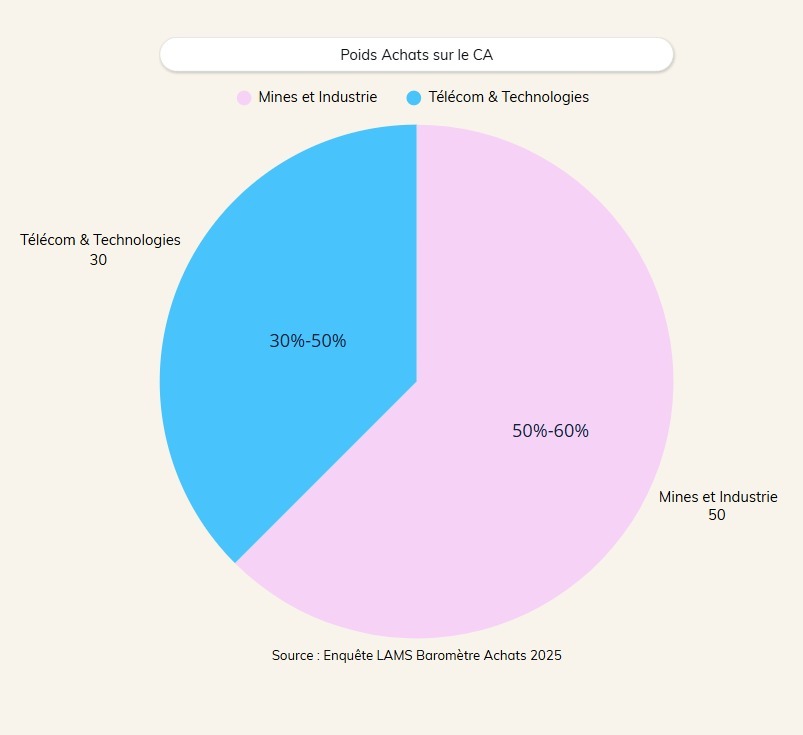
This development is all the more important as our 2025 purchasing barometer shows that in Guinea purchasing often accounts for between a quarter and half of the budget of the organisations surveyed, with levels of up to 50% in some extractive sectors. When a pilot function is potentially such a share of expenditure, it can no longer be regarded as a mere administrative function.
- You present Purchasing as a performance lever for businesses. Why do you think this function is still underestimated in many African organizations?
I think there are several reasons. The first is cultural and organizational. In some organizations, purchasing and procurement are still confused. Buying means then receiving a need, asking for some quotations, negotiating the price, and placing an order.
Purchases begin well before the order. It is necessary to analyse expenditure, challenge the need, define a strategy, study the supplier market, reason in cost TCO, negotiate, contract, manage risk and manage supplier performance.
Our Purchasing-Guinea Barometer 2025 (Practics, Challenges, Prospects) illustrates this situation: about 53 per cent of the companies surveyed separated Procurement from Procurement, while 37 per cent still operate with a shared purchasing/supply organization.
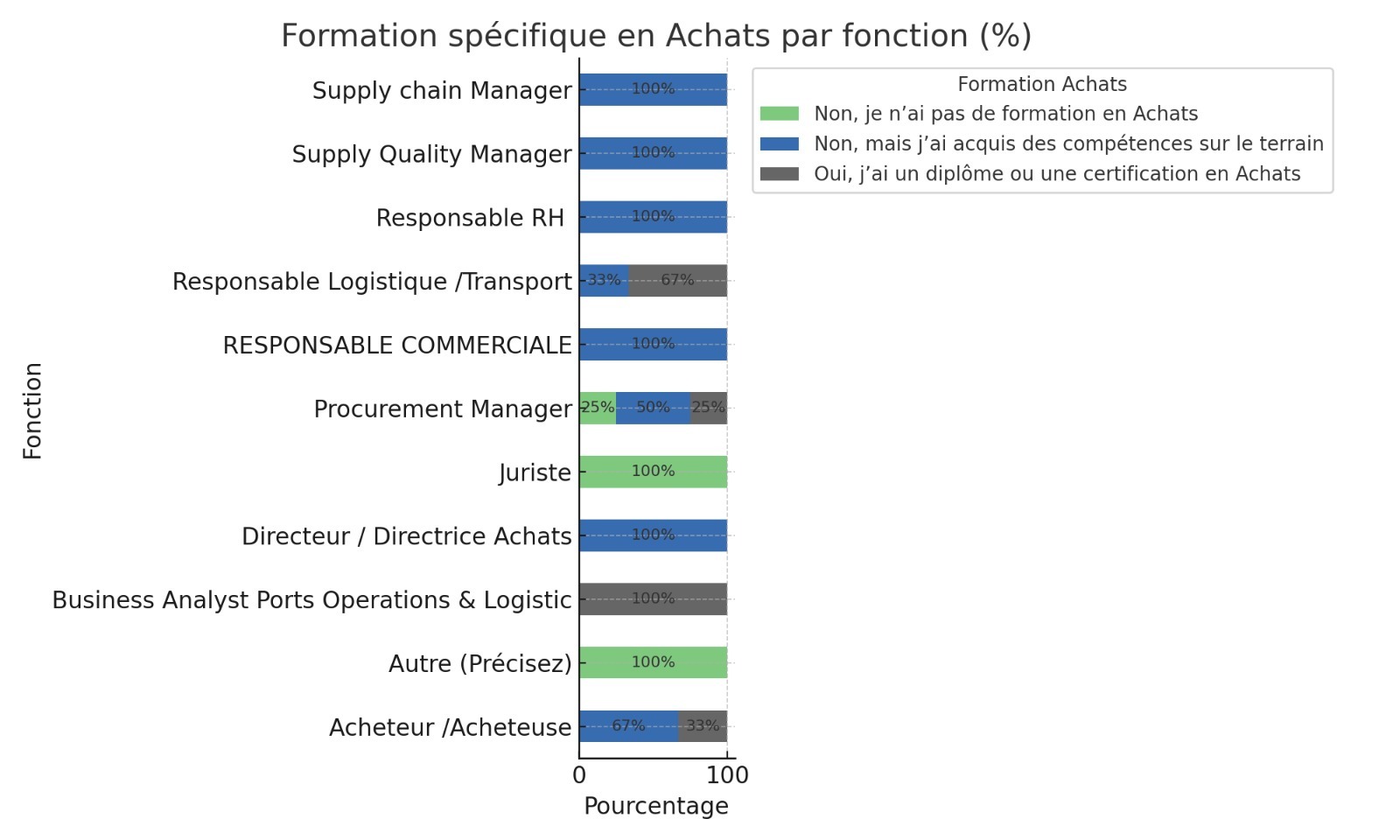
The second difficulty concerns skills. Only 26% of respondents have a formal degree or certification in Purchasing, while 58% say they have mainly acquired their skills on the job. I am not saying that a person trained in the field cannot become an excellent buyer.
On the contrary. But when we want to transform a function, we need to complement experience with structured methods, tools and skills. This is probably why 15 out of 19 companies place employee training among their priorities for improvement.
- Your Purchasing, CSR & IA Barometer – Guinea 2025 shows that less than 20% of respondents have a formalised purchasing process. What does this finding reveal about the maturity of Guinean companies?
First of all, I would like to make a little clarification on this question (this figure). Our Barometer does not show that less than 20% of respondents have a formalised purchasing process. Rather, it highlights a more contrasting situation, with a purchasing function already present in the vast majority of organizations surveyed, but which still presents needs for structuring and formalization.
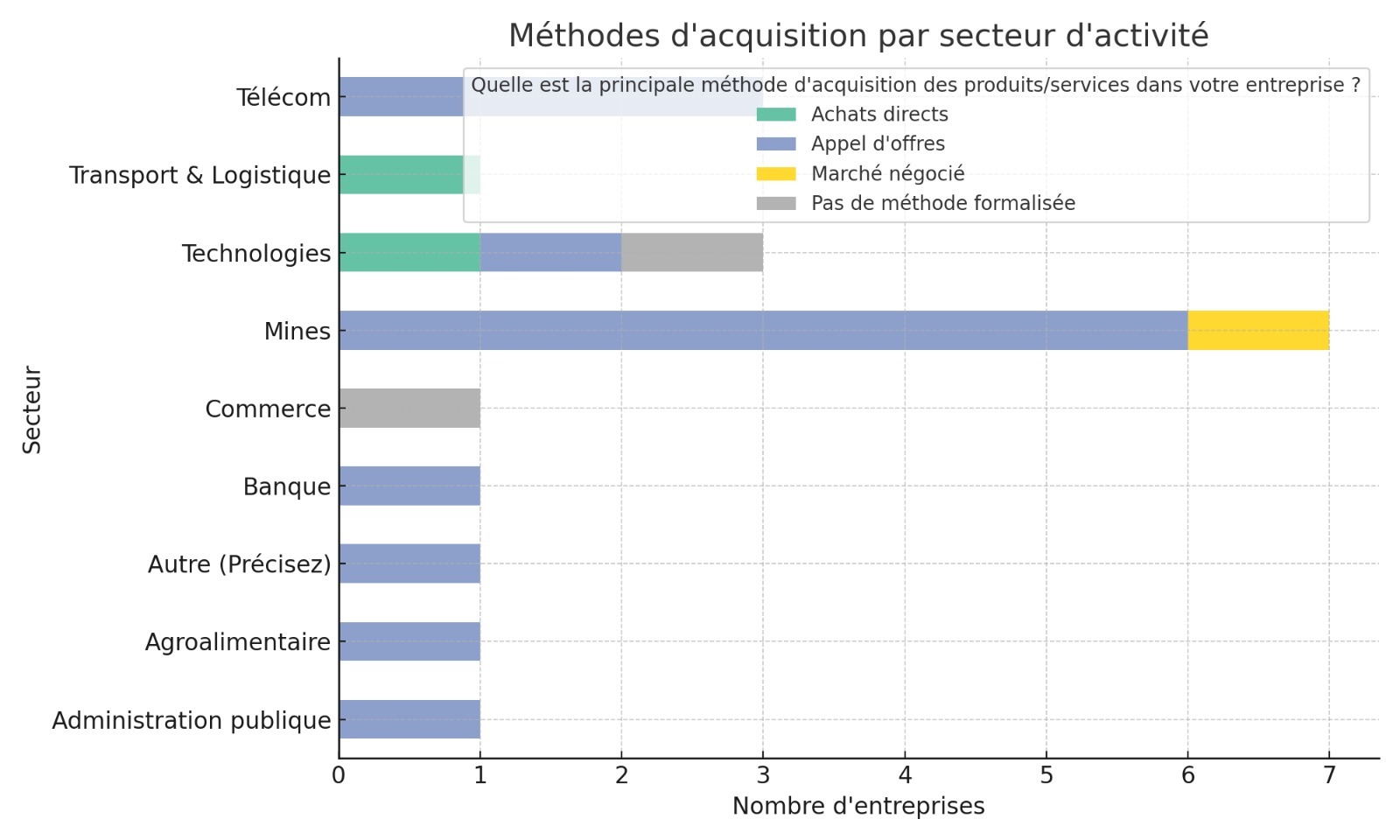
The barometer shows this: 95% of respondents say they have a purchasing service or a function in the process of being established, which is already very encouraging. And 74% cite tender as the preferred method of acquisition.
On the other hand, when we look at maturity in greater depth, there are still needs for formalization, clarification of responsibilities and separation between Strategic Procurement and Operational Procurement. It is also revealing that 10 companies have cited a formalised process as one of their priorities for improvement.
For me, this means that the Guinean Purchasing function is not non-existent: She's in the professionalization phase. And it's very different. These results therefore show that the Purchasing in Guinea function already has a solid foundation, while revealing important opportunities for structuring, professionalization and maturing.
- How can a company move from a primarily administrative purchasing function to a truly strategic one, capable of influencing costs, risks and competitiveness?
I would start with an extremely simple thing: knowing what to buy. How much do we spend? What families? How many suppliers? Which are our strategic suppliers? Where do we have addictions? What contracts are coming to an end? Where are the main risks? It's Spend Analysis and Expenditure Mapping.
Secondly, the process must be structured: expression of need, sourcing, tendering, negotiation, contracting, procurement, evaluation and piloting supplier. Step three: Build strategies by family of Purchases and segment suppliers according to their criticality.
Fourth element: putting indicators in place. Not just savings should be measured. We can measure contractual coverage, deadlines, quality, supplier risks, OTIF, TCO, dependency level, CSR performance or internal customer satisfaction.
Our Barometer also shows that the directorates interviewed are particularly interested in the efficiency of the organization Purchases and the risks/compliance suppliers, with 15 quotes each. Finally, we need the skills and support of Top Management. A digital tool alone will never transform a Purchasing function. Transformation begins with organization, processes, skills and data.
- The Barometer also shows a significant gap between the interest in artificial intelligence and its actual use in companies. What uses of AI seem to you today the most relevant for transforming Purchasing?
I see artificial intelligence as a co-pilot of the buyer, not as his replacement. It can first enable us to automate certain repetitive and time-consuming tasks in order to give back time to the buyer for activities with higher added value. It can also intervene in Spend Analysis, sourcing and search suppliers, comparative analysis of tenders, preparation of negotiations, analysis of contracts, detection of supplier risks, predictive analysis or aid in decision-making.
This is interesting because the companies surveyed in our Barometer first identify as benefits of AI efficiency improvement, better data analysis and automation of repetitive tasks. But I'm putting an important condition: no efficient d
Our study accurately identifies data quality and infrastructure as one of the barriers to digitalization and AI. So I would say to companies: don't necessarily start by looking for the most sophisticated tool of AI. Start by structuring your processes and data, identify two or three cases of usage with a measurable ROI, experiment, and deploy gradually.
- CSR remains poorly integrated in the procurement process in Guinea. What explains this delay and how can companies gradually incorporate responsible purchasing criteria?
Here too, our Barometer brings an interesting shade: the dynamics already exist, but there is still a gap between intentions and the systematic integration of CSR in decisions. For example, 53% of respondents say they use CSR criteria in selecting their suppliers, while 47% do not yet formally integrate them.
68% say they have a written and documented responsible purchasing policy. So the subject is no longer just raising awareness. The next challenge is to transform CSR into measurable purchasing criteria.
This can start very simply: incorporate criteria related to QHSE, working conditions, ethics, the environment, carbon emissions, local content or local employment into tenders. These criteria are then weighed in the analysis of offers, translated into contractual commitments and measured with KPIs.
Suppliers must also be accompanied. The aim is not to automatically exclude a local SME because it has not yet reached all the standards of a large international group. We can build a supplier progress plan with her. This is particularly important in Africa: Responsible Procurement must also contribute to the development of the local economic fabric.
- Beyond Guinea, what do you think are the main challenges that African procurement professionals will face in the coming years?
I see many, but they are deeply connected. First, professionalize the purchasing function and develop skills. Then, secure Supply Chain in an environment marked by price volatility, logistical issues, exchange rates, geopolitical risks and sometimes a high dependence on imports.
Issue 3: developing local content without sacrificing performance. This is particularly important for Guinea with the development of major mining and infrastructure projects, particularly around Simandou. The challenge is not simply to say: « Buy Local ».
Local suppliers must be helped to meet the quality, cost, time, QHSE, CSR and industrial capacity requirements of major suppliers. Then, of course, digitalization, the AI and the Data. And finally, the transition to responsible purchasing.
However, I think that Africa has an advantage: some organizations can jump into technological steps and adopt modern solutions directly. This is also one of the opportunities identified in our Barometer. Our delay on certain topics can therefore also become an opportunity for acceleration.
- Through LAMS Consulting, you support companies in optimizing costs, transforming processes and increasing team maturity. On what levers should companies take priority today?
I would advise not to start immediately by buying a new ERP or a solution from AIA. Start with a diagnosis: Data Management at Purchasing. « Only what can be measured can be improved. » What is our level of maturity? What are our processes? Our skills? Our organization? Our expenses? Our critical suppliers? Our risks? Our tools? It's all about data management. From this diagnosis, a roadmap (strategy) is being built with some priorities for action.
Several levers can be activated according to categories: volume massification, competition and sourcing, negotiation, rationalization of the supplier panel, standardization of requirements, Demand Management, cost analysis TCO, Make or Buy or multi-annual contracts with price revision formula.
And I insist on one point: optimising costs does not always mean buying cheaper. A company can get a lower price and then lose more in maintenance, non-quality, supply disruption or logistics costs. The aim must therefore be to optimise the overall cost while controlling risks and performance.
And the companies interviewed in our Barometer themselves give us a very clear indication: 15 out of 19 cite the training of employees, 13 the development of a responsible purchasing policy, a strategy 14 integrating CSR and risk management suppliers. This would include formalization of processes, the Spend Analysis, digitization and implementation of decision-making dashboards to drive performance. I would therefore sum up this process of transformation into seven stages:
Diagnosis → Structure → Optimize→ Form → Digitalize → Measure
And then, of course: continuously improved.
- What message do you want to send to African purchasing managers and managers who want to make their Purchasing function a real engine of competitiveness?
I would first like to address the leaders. Do not consider Purchases solely as a cost centre or a service to place orders. Where external expenditure can represent such a large part of an organisation's budget, the quality of procurement management directly influences profitability, risk and competitiveness.
To the procurement professionals, I would say: Keep training. Learn about negotiation, Data, Contract Management, cost analysis TCO, CSR, risk management and artificial intelligence. But let us never forget our knowledge of the field and the human relationship with our internal suppliers and customers.
And I would also like to send a message to African suppliers: structure yourself, invest in your skills, quality, QHSE, digitalization and CSR. The major projects that are developing on the continent must become an opportunity to create African companies capable of growing and becoming internationally competitive.
Finally, I think we need to change the way we measure the success of Purchasing. A real saving is important. But real performance is also a risk avoided, a break-up prevented, a developed local supplier, an innovation made, a reduced environmental footprint or a strengthened partnership. That's why I often summarize my vision with this conviction: « Let's not just save money, let's create value! »
And this value must benefit the company, suppliers, territories and, more broadly, our African economies.