



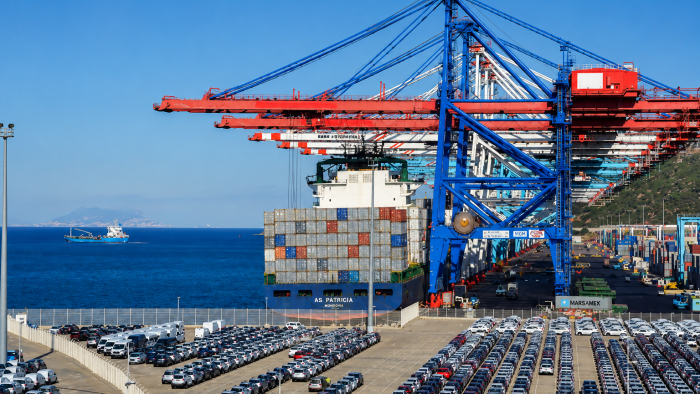
The future container terminal at Nador West Med continues its equipment with a view to its planned start-up in late 2026. Two new dock cranes have just been delivered, bringing to five the number of equipment already installed on the site, as part of the development of this new Moroccan port platform.
On July 21, 2026, the West Med Container Terminal (WMCT) welcomed two new dock portal cranes, transported entirely aboard the ship Zhen Hua 24 of Chinese manufacturer Shanghai Zhenhua Heavy Industries (ZPMC).
Their installation now brings to five the number of dock cranes deployed on the East container terminal, operated by a joint venture between Marsa Maroc and Terminal Investment Limited (TiL), the harbour subsidiary of the MSC shipowner.
Both equipment have a lifting height of 54 metres, a tandem lifting capacity of 65 tons and a range of 71.5 metres, allowing them to handle 24-row containers.
This new delivery is part of the terminal preparation schedule, which is expected to start in the fourth quarter of 2026. In parallel, the construction site is gradually receiving portal cranes on electric tyres provided by Chinese manufacturer GENMA Solutions.
After shipping ten units in June, eight have already been delivered, while a new batch of ten other cranes is on their way to Morocco. These equipment will strengthen the operational capabilities of the terminal as soon as it is opened.
In the long term, the programme includes the installation of 15 dock portal cranes and 45 port cranes on electric tyres. Once all phases of the project have been completed, the terminal is expected to reach an annual capacity of 3.4 million twenty-foot equivalents (TEUs), thus strengthening the container processing capacity on the Moroccan Mediterranean facade.
With the development of Nador West Med, Morocco continues its strategy to consolidate its position as a regional logistics platform.
Increasing handling capacity, combined with investments in port infrastructure and latest generation equipment, should help attract more international maritime services, while strengthening the competitiveness of logistics chains linking Europe, the Mediterranean and the African continent.




