



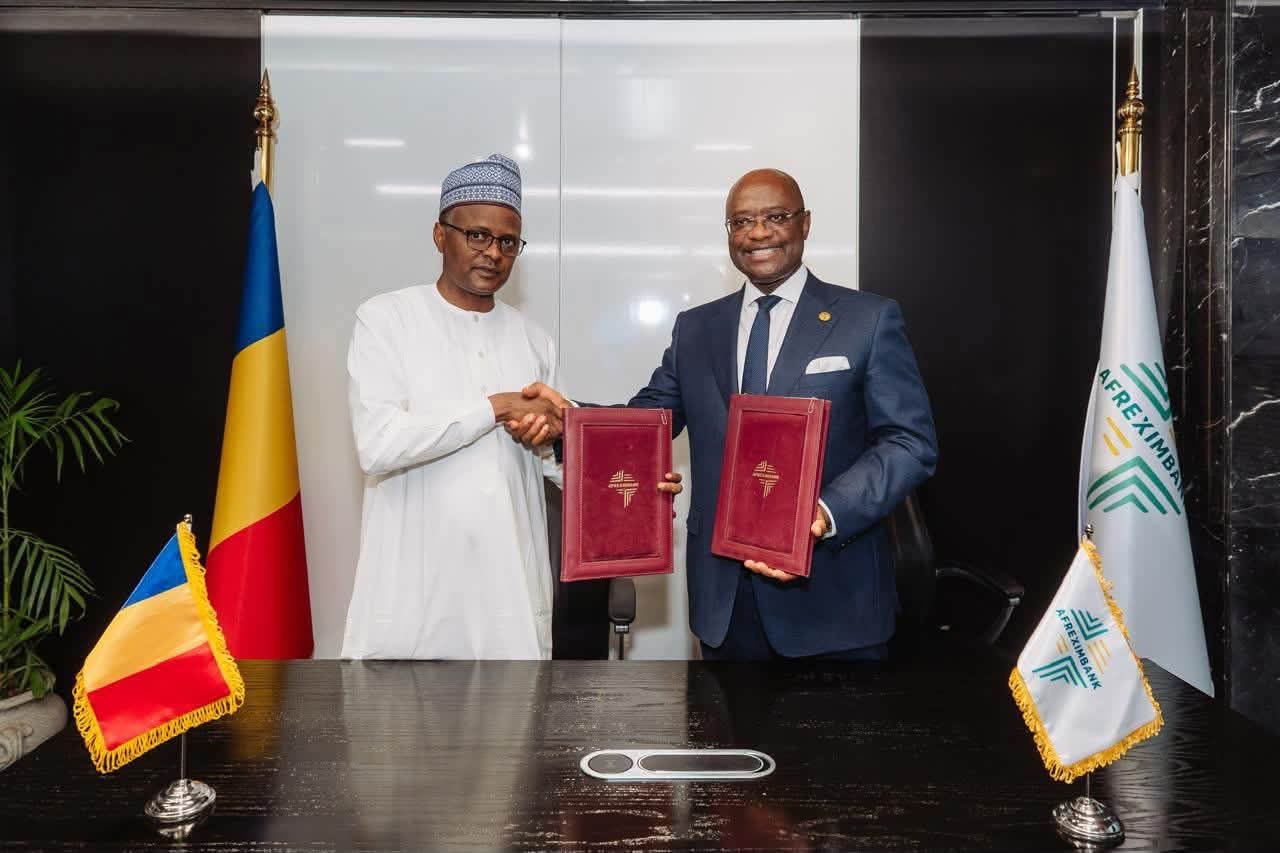
Afreximbank has granted the Chadian government a financing facility equivalent to EUR 110 million to support infrastructure projects under the 2026 Finance Act. In particular, the envelope must contribute to improving the country's trade connections and to supporting the diversification of its economy.
The agreement was signed on 5 August 2026 at the headquarters of Afreximbank in Cairo by Tahir Hamid Nguilin, Minister of State for Finance, Budget, Economy, Planning and International Cooperation of Chad, and George Elombi, President of Afreximbank.
The facility will be made available to the government in local currency in an amount equivalent to €110 million, or approximately $128 million. According to the Pan-African bank, it is its largest financing to date in Chad.
Funds must finance infrastructure to facilitate trade and strengthen the country's economic resilience. Afreximbank cites, inter alia, transport projects linking Chad with Egypt and Libya, electricity infrastructure and the development of crude oil refining capacity.
The programme also includes industrial areas specializing in textile production and meat processing, as well as transport and economic projects around Lake Chad.
This intervention is part of the Memorandum of Understanding concluded in June 2025 between Chad and Afreximbank. It covers several sectors, including agriculture for export, development of agro-pastoral potential, gold trade, refined petroleum products, refining and airworthiness of Lake Chad.
For a landlocked country, improving transport infrastructure and links with neighbouring countries is also an issue to reduce the constraints associated with the movement of goods to regional and international markets.
Funding is being provided as N的Djamena seeks to reduce its dependence on crude oil revenues. The proposed investments should promote more local transformation in several sectors and broaden the country's productive base.
The World Bank forecasts growth of 5.2 per cent in 2026 for Chad, in a context where developments in the oil sector and the implementation of investments remain crucial for economic activity.




